

2026 GMC Sierra 2500HD Engine Options: 6.6L Gas vs Duramax Diesel — Which Is Right for You?
2026 GMC Sierra 2500HD Engine Options: 6.6L Gas vs Duramax Diesel — Which Is Right for You?
Learn more about Ryan
The 2026 GMC Sierra 2500HD offers two distinct powerplants: the proven 6.6L V8 gas engine and the revolutionary Duramax 6.6L Turbo-Diesel. The gas option provides straightforward reliability and simpler maintenance. The Duramax diesel delivers game-changing torque—especially the 25% improvement at lower RPM new for 2026—making it ideal for Colorado’s mountain terrain, serious towing, and altitude driving. Your choice fundamentally shapes how your truck performs on I-25 grades, mountain passes, and every mile between Greeley and the Rockies.
Quick Answer: Gas or Diesel for Your 2026 Sierra 2500HD?
Choose the 6.6L V8 gas engine (401 hp, 464 lb-ft) if you tow occasionally, prefer lower purchase price, and want maximum simplicity. Choose the Duramax 6.6L Turbo-Diesel (470 hp, 975 lb-ft) if you tow regularly, drive Colorado mountains, or want superior fuel economy. The 2026 Duramax’s 25% lower-RPM torque increase makes it more compelling than ever for Northern Colorado drivers navigating altitude, grades, and heavy towing.
2026 GMC Sierra 2500HD 6.6L V8 Gas Engine
Engine Specifications
Key Characteristics
- Naturally aspirated (no turbo) — simpler, fewer components to maintain
- Proven reliability across millions of trucks globally
- Lower upfront purchase price than Duramax option
- Straightforward maintenance with standard oil changes every 10,000 miles
- No diesel particulate filter regeneration cycles
- Excellent for occasional towing and mixed-duty work
Gas Engine Performance & Towing
The 6.6L V8 gas engine delivers 401 horsepower and 464 lb-ft of torque, making it fully capable of handling the Sierra 2500HD’s maximum towing capacity of 22,500 lbs with a gooseneck hitch. This engine excels in city driving, moderate towing, and situations where fuel availability might be a concern on remote Colorado roads.
However, on long mountain grades—climbing I-25 to Vail Pass, navigating forest service roads above 8,000 feet, or sustained towing through the Colorado Rockies—you’ll feel the engine working. At altitude, naturally aspirated engines lose efficiency, and the gas engine’s 464 lb-ft doesn’t provide the margin of comfort the Duramax offers. When you’re climbing a 6% grade while towing a loaded 30-foot trailer at 9,000 feet elevation, you’ll understand why many Northern Colorado buyers upgrade to diesel.
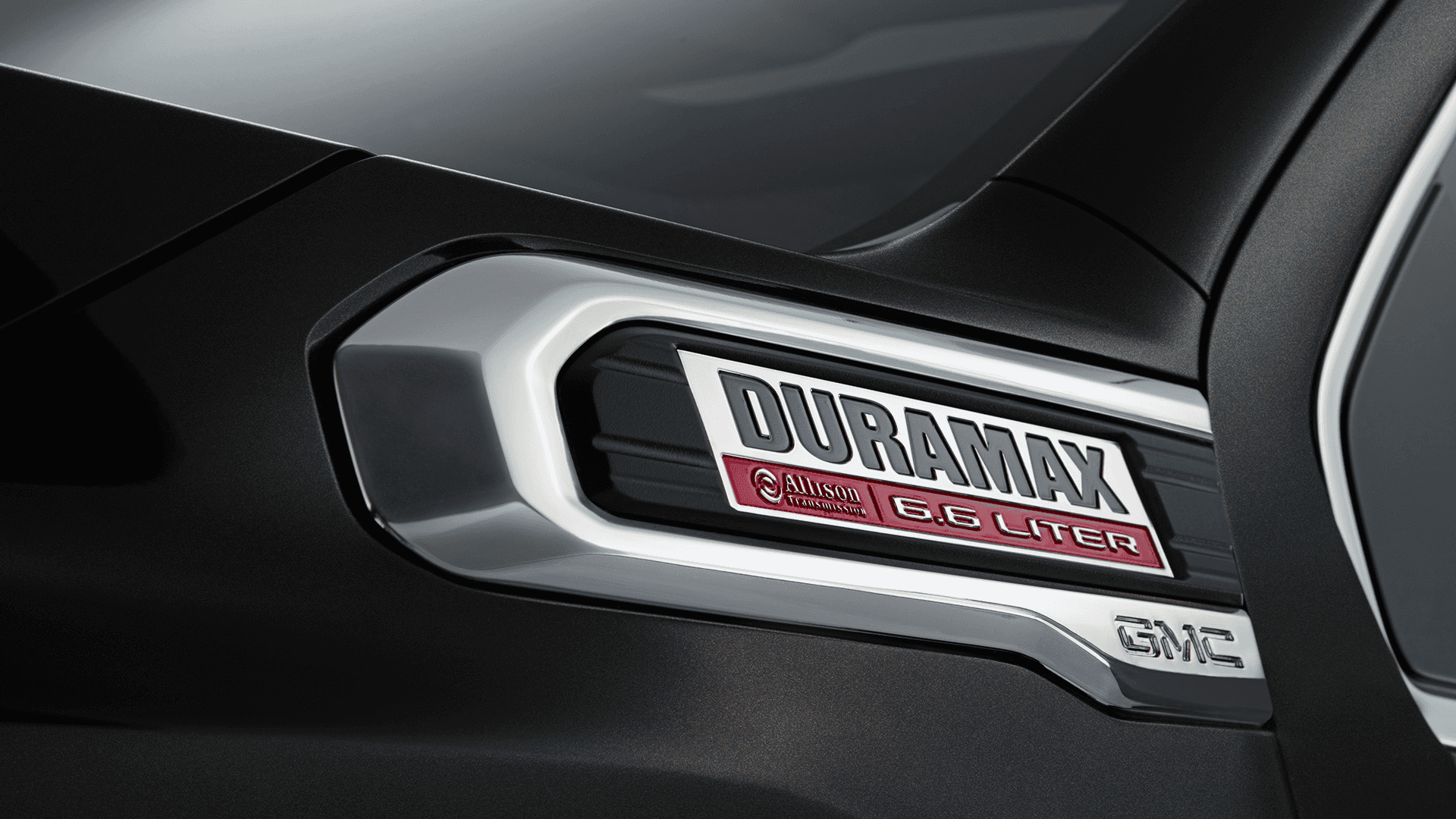
2026 GMC Sierra 2500HD Duramax 6.6L Turbo-Diesel V8
Engine Specifications
2026 NEW: 25% Lower-RPM Torque Increase
The 2026 Duramax diesel now delivers 25% more torque at lower RPM compared to the 2025 model. This dramatic improvement means the engine achieves maximum pulling power much sooner, making acceleration from a standstill dramatically better, and mountain grades feel effortless even at altitude.
Key Characteristics
- Class-leading torque: 975 lb-ft is the most in its class, with 25% more at low RPM in 2026
- Turbocharger provides consistent power even at Colorado’s high altitudes
- Paired with Allison 10-speed automatic transmission for optimal efficiency
- Approximately 22% better fuel economy than gas engine
- Excellent for regular towing and extended mountain operation
- Longer engine lifespan — 250,000+ miles common with proper maintenance
The Game-Changing 2026 Upgrade: Lower-RPM Torque Increase
For 2026, GMC engineered a 25% increase in Duramax torque availability at lower RPM. This isn’t a minor update—it’s a transformative improvement that fundamentally changes how the engine behaves on Colorado’s challenging roads. Where the previous Duramax required higher RPM to access its maximum pulling power, the 2026 version delivers that power immediately from a standstill and through the lower RPM range.
What does this mean practically? Climbing I-25 to Vail Pass at 8,000+ feet elevation while towing a 30-foot fifth wheel: the engine pulls smoothly without searching for power or downshifting. Launching from a stop with a loaded trailer is brisk and confident instead of slow and laborious. Mountain highway passes feel dramatically easier. This torque availability at lower RPM is especially valuable at altitude, where air is thin and naturally aspirated engines (like the gas V8) struggle.
Diesel Performance Across Colorado Terrain
The 2026 Duramax diesel delivers 975 lb-ft of torque from just 1,500 RPM, and with the new 25% low-RPM boost, acceleration and grade-climbing capability are unmatched. Compare this to the gas engine’s 464 lb-ft peak (achieved at higher RPM), and you understand why serious truck users in Northern Colorado choose diesel.
On specific challenges you’ll face:
- I-25 Mountain Grades: The Duramax maintains speed effortlessly on sustained grades. The 25% lower-RPM torque improvement means you stay in top gear longer, improving efficiency and reducing heat stress.
- High-Altitude Operation: Greeley sits at ~5,000 feet. Loveland and Fort Collins approach 5,500 feet. Mountain passes exceed 10,000 feet. The turbocharger maintains full boost even at altitude, while the gas engine loses roughly 3.5% power per 1,000 feet of elevation gain.
- Mountain Fire Roads: Whether you’re exploring forest service roads or navigating tight switchbacks, the diesel’s torque gives you margin for error and confidence in challenging terrain.
- Trailer Sway Control: The diesel’s superior power allows faster acceleration to stabilize a swaying trailer, improving safety on windy I-25 corridors.
Head-to-Head Engine Comparison
| Specification | 6.6L V8 Gas | Duramax 6.6L Diesel |
|---|---|---|
| Horsepower | 401 hp | 470 hp |
| Peak Torque | 464 lb-ft @ higher RPM | 975 lb-ft @ 1,500 RPM |
| 2026 Torque at Low RPM | N/A (nat. aspirated) | +25% vs 2025 model |
| Max Towing | 22,500 lbs (GN) | 22,500 lbs (GN) |
| Max Payload | 3,759 lbs | 3,759 lbs |
| Fuel Economy | ~19-21 mpg | ~23-26 mpg |
| Transmission | 10-speed auto | 10-speed auto (Allison) |
| Altitude Performance | Loses power above 7,000 ft | Turbo maintains boost |
| Engine Life Expectancy | 180,000-220,000 miles | 250,000+ miles |
| Maintenance Frequency | Every 10,000 miles | Every 7,500 miles |
Fuel Economy & Operating Costs
The Duramax diesel achieves approximately 22% better fuel economy than the gas engine in EPA combined driving. In real-world Northern Colorado operation, users report 23-26 mpg with the diesel versus 19-21 mpg with gas, depending on towing loads and driving conditions.
Diesel fuel typically costs $0.10-0.30 more per gallon than gasoline, but the efficiency advantage often more than compensates. Let’s look at typical annual costs for someone towing regularly in Colorado:
Annual Fuel Cost Example (15,000 miles, 50% towing)
Gas Engine: 15,000 miles ÷ 19.5 mpg average = 769 gallons × $3.50/gal = $2,692
Diesel Engine: 15,000 miles ÷ 24 mpg average = 625 gallons × $3.70/gal = $2,313
Diesel savings: $379/year
Over a 5-year ownership period, diesel fuel cost savings alone approach $2,000. When you add in the diesel’s superior torque (reducing engine stress and transmission wear), superior longevity (250,000+ mile capability), and lower maintenance costs per mile, the diesel investment pays for itself.
Which Engine is Right for You? A Decision Guide
Choose GAS (6.6L V8) If:
- You tow occasionally (less than 3,000 miles annually)
- You prefer lower upfront cost and simpler maintenance
- You drive primarily around Greeley/Fort Collins on flat terrain
- You value straightforward reliability over maximum performance
- You primarily haul light loads or work materials
Choose DIESEL (Duramax) If:
- You tow regularly (more than 5,000 miles annually)
- You drive Colorado mountain passes and high-altitude roads
- You want class-leading torque for smooth, effortless pulling
- You value long-term fuel economy and engine longevity
- You need confidence on I-25 grades while towing heavy trailers
- You can justify the higher upfront cost with lower operating expenses
Colorado Altitude: The Diesel Advantage
This is critical for Northern Colorado buyers: altitude significantly impacts engine performance. Greeley sits at approximately 4,600 feet. Fort Collins is near 5,000 feet. Common mountain passes range from 8,000-11,000 feet. At these elevations, air density drops dramatically, affecting both gas and diesel engines—but diesel far less severely.
A naturally aspirated gas engine loses approximately 3.5% power per 1,000 feet of elevation. This means at 10,000 feet (Vail Pass), your 401 hp gas engine is operating at roughly 355 hp equivalent—a 12% loss. The Duramax diesel, with its turbocharger, maintains consistent boost pressure regardless of altitude, meaning you retain nearly full power even at 11,000+ feet elevation.
For someone towing a loaded trailer through mountain passes, this altitude advantage is transformative. The gas engine requires downshifting and laboring to maintain speed. The Duramax pulls smoothly and efficiently, saving fuel and reducing heat stress on the engine and transmission. If you’re climbing Vail Pass regularly, or exploring Colorado’s high country, the diesel isn’t optional—it’s essential.
Maintenance & Longevity
The gas engine requires oil changes every 10,000 miles and is generally simpler to maintain. Spark plugs need occasional replacement, and there’s less complexity overall. However, most gas-powered heavy trucks reach 180,000-220,000 miles before major rebuilding is necessary.
The Duramax diesel requires oil changes every 7,500 miles, diesel fuel filter replacements, and attention to diesel particulate filter regeneration (the truck occasionally burns excess fuel to clean internal filters). These maintenance items cost more per service, but diesel engines commonly exceed 250,000 miles with proper care. The longer service life—an additional 50,000+ miles—effectively spreads costs over more mileage, often making diesel cheaper per mile despite higher maintenance costs per service.
Frequently Asked Questions About 2026 Sierra 2500HD Engines
More 2026 GMC Sierra 2500HD Guides
Weld County Garage GMC — Greeley, CO
Ready to Choose Your Perfect 2026 Sierra 2500HD Engine?
Test drive both gas and diesel options at our Greeley dealership. Feel the difference firsthand. Visit 2699 47th Ave, Greeley, CO 80634 or call 970-400-9952. Serving all of Northern Colorado.
0 comment(s) so far on 2026 GMC Sierra 2500HD Engine Options: 6.6L Gas vs Duramax Diesel — Which Is Right for You?