

2026 GMC Yukon XL Towing Capacity & Capability
2026 GMC Yukon XL
Towing Capacity & Capability
By Ryan Green, Marketing Director — Weld County Garage GMC | Updated June 2026
Quick Answer
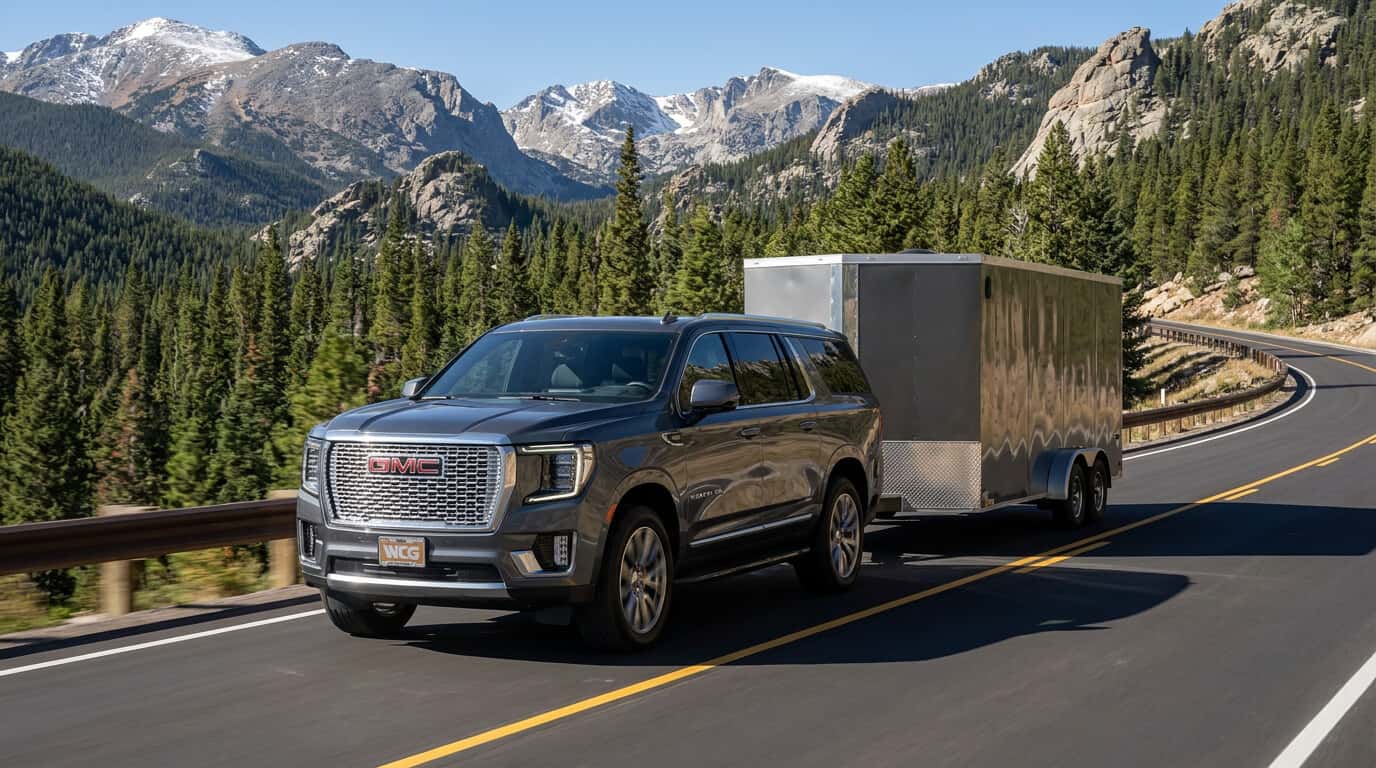
The 2026 GMC Yukon XL tows up to 8,400 lbs with the 5.3L V8, 2WD, and Max Trailering Package; the 6.2L V8 and Duramax reach 8,200 lbs. The extended-wheelbase XL rates about 100–200 lbs under the short Yukon, trading a little towing for far more cargo and third-row room.
Whether you’re towing a boat to Horsetooth Reservoir, a horse trailer to mountain trails, or a camper toward Steamboat, the XL’s engines and integrated trailering tech make every tow confident and controlled.
The 2026 GMC Yukon XL delivers serious towing capability with up to an 8,400-lb maximum capacity, making it one of the most capable full-size SUVs in the segment—and the most spacious. Whether you’re towing a boat to Horsetooth Reservoir, a horse trailer to mountain trails, or a camper for a Rocky Mountain adventure, the XL’s powerful engines and integrated trailering technology make every tow confident and controlled. We’ll be honest about how the extended-wheelbase XL compares to the short Yukon, and show Colorado drivers exactly how to reach the rating.
Core Capability
How to Reach the 8,400-lb Max Tow Rating
Not every Yukon XL configuration reaches the maximum 8,400-lb towing capacity. To hit this benchmark you need three specific ingredients:
Required for 8,400 lbs
Engine: 5.3L V8 with 355 hp and 383 lb-ft of torque. Package: Max Trailering Package (integrated hitch platform, trailer brake controller, and heavy-duty cooling). Configuration: 2WD. This combination unlocks the XL’s full towing potential.
Honest Comparison: XL vs Short Yukon
The extended-wheelbase Yukon XL is about 15 inches longer (225.2 in overall) and heavier than the short Yukon, so it rates roughly 100–200 lbs under its sibling at every engine. That’s the trade for the XL’s huge cargo and third-row room. If absolute maximum tow is your top priority, the short Yukon edges it out; if you want maximum people-and-gear space with strong towing, the XL is the call.
Important limitations: Choosing 4WD reduces capacity to around 8,000 lbs—the added weight and lower final-drive ratios offset the capability slightly. If you need maximum towing and plan to pull from higher elevations in the Rockies, 2WD with the 5.3L V8 is your optimal Yukon XL configuration.
Trailering Systems
Integrated Towing Technology
The Max Trailering Package bundles critical systems for safe, confident towing of the longer Yukon XL through Colorado’s mountain terrain.
By Engine
Towing Capacity by Engine
| Engine | Horsepower | Torque | Max Towing (2WD/4WD) | Best For |
|---|---|---|---|---|
| 5.3L V8 | 355 hp | 383 lb-ft | 8,400 / 8,000 lbs | Max tow rating |
| 6.2L V8 | 420 hp | 460 lb-ft | 8,200 / 8,000 lbs | Peak power |
| 3.0L Duramax | 305 hp | 495 lb-ft | 8,200 / 8,000 lbs | Mountain towing |
The 3.0L Duramax stands out for Colorado mountain towing with the XL. Despite lower horsepower, its 495 lb-ft of torque (highest of the three) and turbocharger deliver superior low-end grunt for the heavier extended-wheelbase body. At altitude the Duramax’s turbo intake boost compensates for thinner air, making it the preferred choice for I-70 west of Denver and I-25 north toward Fort Collins.
Critical Knowledge
Payload vs Towing: What’s the Difference?
Know the Difference
Payload and towing capacity are distinct limits determined by your Yukon XL’s Gross Vehicle Weight Rating (GVWR).
Towing is what you pull behind the vehicle; payload is how much weight you can load inside or on top. Tongue weight counts against your payload, not your towing limit—and with the XL’s huge cargo hold it’s easy to load more than you think.
Payload Explained: The 2026 GMC Yukon XL’s payload capacity runs roughly 1,600–1,770 lbs depending on trim, engine, and drivetrain (the longer body trims a bit off the short Yukon’s figure). This is the maximum weight you can safely add inside the cabin and cargo area—passengers, gear, and aftermarket equipment.
Tongue Weight Counts: Your trailer’s tongue weight (the downward force the trailer hitch exerts) counts against your payload, NOT your towing limit. For example, towing a 6,000-lb boat with 600 lbs of tongue weight reduces your available payload by that 600 lbs—watch it closely when the third row is full of passengers.
GVWR (Gross Vehicle Weight Rating): Think of GVWR as your vehicle’s total weight limit. You can check your GVWR on the door-jamb placard. Never exceed it—it affects braking, suspension geometry, and tire safety, all the more critical in the longer XL.
Setup & Installation
What’s in the Max Trailering Package?
Hitch Platform
Integrated Class III/IV hitch receiver with proper geometry and attachment points rated for the Yukon XL’s full towing capacity.
Trailer Brake Controller
Proportional braking system that automatically senses trailer braking and modulates brake power. Essential for mountain descents with the heavier XL.
Heavy-Duty Cooling
Upgraded engine and transmission cooling to manage heat during sustained towing at high altitude.
Transfer Case (4WD)
2-speed transfer case provides low-range torque multiplication for terrain control and towing stability.
Advanced Features
Towing Technology
Setup Essentials
Tongue Weight & Proper Setup
The 10–15% Rule
Tongue weight should be 10–15% of total trailer weight—no more, no less.
Too little tongue weight (under 10%) causes trailer sway and whipping. Too much (over 15%) overloads your Yukon XL’s rear axle and reduces front-end traction.
Example: A 6,000-lb travel trailer should have 600–900 lbs of tongue weight. Under-weighted trailers sway on highways; over-weighted trailers compress the rear suspension, causing the front wheels to lose contact with the road—a bigger concern with the XL’s longer rear overhang.
Weight-Distributing Hitch Recommendation: For trailers over 5,000 lbs, use a weight-distributing hitch. It redistributes tongue weight across all four Yukon XL tires, maintains suspension geometry, reduces rear-axle sag, improves steering response, and enhances braking. Critical on Colorado mountain roads.
Mountain Strategy
Towing in the Rockies: Colorado Essentials
Altitude Power Loss
Naturally aspirated engines lose roughly 3–5% of power per 1,000 feet of elevation gain.
At 10,000 feet (near Loveland Pass), the 5.3L V8 operates at only about 70% of its sea-level power output. The 3.0L Duramax turbocharged diesel compensates with turbo boost, maintaining near sea-level power even at altitude—a real advantage when the heavier XL is climbing.
Colorado’s Steepest Grades: I-70 west of Denver features long, sustained 6–8% grades. US-34 through Estes Park has 7–10% grades with sharp switchbacks. Berthoud Pass (11,315 ft) has 9–11% downhill grades on descent. Loveland Pass (12,009 ft) is even steeper. Poudre Canyon (US-14) is scenic but exposed to high crosswinds that the long XL feels.
Activate Tow/Haul Mode on Every Descent: This is non-negotiable. Tow/Haul locks the transmission in lower gears, forcing the engine to brake rather than relying solely on trailer brakes. It prevents brake fade and keeps the loaded XL in control on steep drops.
Trailer Brake Inspection Before Mountain Trips: Before any mountain tow, have a technician inspect brake pads, rotors, drums, and the brake controller wiring. A trailer with worn brakes behind a heavy XL on Berthoud Pass is a disaster waiting to happen.
Why the 3.0L Duramax Dominates Mountain Towing: The turbocharger’s boost compensates for altitude, delivering full power throughout the climb. The 495 lb-ft of peak torque applies force at low RPM during slow, grinding climbs, and diesel fuel has higher energy density than gasoline. For serious Colorado mountain towing with the XL, the Duramax is the smart choice.
Questions
Frequently Asked Questions
Weld County Garage GMC — Greeley, CO
Ready to Tow with Confidence?
Visit us at 2699 47th Ave, Greeley, CO 80634 or call 970-400-9952. Serving Northern Colorado since 1908.
0 comment(s) so far on 2026 GMC Yukon XL Towing Capacity & Capability