At a Glance
The 2026 GMC Yukon offers three distinct engines to match your driving style and towing needs. Whether you prioritize everyday efficiency, maximum power, or mountain-altitude performance, the Yukon delivers.
With options ranging from 355 to 420 horsepower and up to 495 lb-ft of torque, plus a standard 10-speed automatic, you’ll find the right combination for Northern Colorado driving.
The 2026 GMC Yukon offers three distinct engines to match your driving style and towing needs. Whether you prioritize everyday efficiency, maximum power, or mountain-altitude performance, the Yukon delivers. With options ranging from 355 to 420 horsepower and up to 495 lb-ft of torque, plus a standard 10-speed automatic, you’ll find the right combination for Northern Colorado driving.
Engine Lineup
5.3L V8, 6.2L V8 & 3.0L Duramax Diesel
All three available engines in the 2026 Yukon are towing-capable, but each brings different strengths to the table.
5.3L V8 (L84)
355 hp / 383 lb-ft
The proven everyday performer. Dynamic Fuel Management deactivates cylinders under light load for maximum efficiency. Standard on Elevation and AT4 trims. Tows up to 8,400 lbs with the right package.
6.2L V8 (L87)
420 hp / 460 lb-ft
Maximum power and luxury feel. 65 more horsepower and 77 additional lb-ft than the 5.3L. Standard on Denali trims. Approx. 8,200 lbs towing capacity.
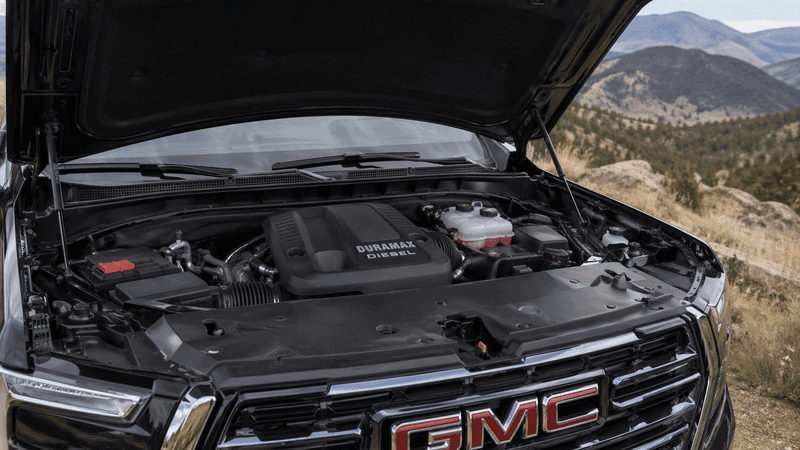
3.0L Duramax Turbo-Diesel I6 (LZ0)
305 hp / 495 lb-ft Torque
Altitude and torque master. Available on all five trims. While slightly lower in peak horsepower, it produces dominant 495 lb-ft of torque. Turbocharger compensates for thin air at elevation—stronger at altitude than either V8. Delivers 3-4 mpg better highway economy. Approx. 8,200 lbs towing.
For Colorado Drivers
Which Engine Is Best for You?
Commuter or Light Towing
Choose the 5.3L V8. It’s the standard on Elevation and AT4, costs less, and handles daily driving and recreational hauling with confidence. Dynamic Fuel Management keeps MPG respectable. Tows up to 8,400 lbs with the right package.
Luxury & Frequent Mountain Driving
Choose the 6.2L V8. You’ll feel the power difference on Colorado passes and weekend trips. The 420 hp and 460 lb-ft deliver responsive acceleration and confident towing. Standard on Denali trims, it pairs luxury features with performance.
Long-Haul & Maximum Torque
Choose the 3.0L Duramax. If you spend significant time on I-25 between Greeley and Denver, cross mountain passes regularly, or tow heavy loads, the turbo-diesel’s 495 lb-ft torque and altitude compensation are the engineer’s choice. Expect 3-4 mpg better economy.
Specifications
Engine Comparison Table
| Feature |
5.3L V8 |
6.2L V8 |
3.0L Duramax |
| Horsepower |
355 hp |
420 hp |
305 hp |
| Torque |
383 lb-ft |
460 lb-ft |
495 lb-ft |
| Max Towing |
8,400 lbs |
~8,200 lbs |
~8,200 lbs |
| Fuel Type |
Gasoline |
Gasoline |
Diesel |
| Est. Hwy MPG |
~22-24 |
~20-22 |
~25-27 |
| Altitude Performance |
Good |
Good |
Excellent |
The 3.0L Duramax stands out for Colorado mountain towing. Despite lower horsepower, its 495 lb-ft of torque (highest of all three) and turbocharger deliver superior low-end grunt. At altitude, where naturally aspirated engines lose power, the Duramax’s turbo intake boost compensates for thinner air.
Greeley sits at 4,500 feet above sea level, but Northern Colorado’s mountain passes climb dramatically higher. Berthoud Pass reaches 11,315 feet, Loveland Pass 12,009 feet. At these elevations, gasoline engines lose power due to thinner air. The Duramax turbocharger forces compressed air into the engine, compensating for altitude effects where V8s naturally fall flat.
Questions
Frequently Asked Questions
What is the difference between the 5.3L and 6.2L V8 engines in the 2026 Yukon?
The 5.3L V8 produces 355 horsepower and 383 lb-ft of torque and is the standard engine on most Yukon trims. The 6.2L V8 is more powerful, producing 420 hp and 460 lb-ft, making it ideal for heavy towing and premium driving feel. Both have Dynamic Fuel Management to improve efficiency. The 6.2L is standard on the Denali trim and optional on others except the base Elevation.
Which 2026 Yukon engine is best for high altitude driving in Colorado?
The 3.0L Duramax turbo-diesel is the best choice for Colorado’s high altitude. Its turbocharger compensates for thin air, maintaining power and fuel economy across mountain passes like Berthoud Pass, Loveland Pass, and Rabbit Ears Pass. The turbo works harder in thinner air, which is an advantage rather than a disadvantage—the engine was engineered for altitude performance. V8 engines naturally lose power at altitude, making the diesel the engineer’s choice for Northern Colorado.
Does the Duramax engine in the Yukon require special diesel fuel in Colorado?
The 2026 Duramax uses standard diesel fuel available at any truck stop or gas station in the Greeley-Fort Collins area. DEF (Diesel Exhaust Fluid) is required for emissions control and is widely available—you can refill at most diesel pumps. Winter-grade diesel is available in Northern Colorado during cold months to prevent gelling. Check your owner’s manual for fuel recommendations and DEF refill intervals.
What’s the maximum towing capacity of each 2026 Yukon engine?
The 5.3L V8 tows up to 8,400 lbs with the Max Trailering Package on a 2WD, short-wheelbase model. The 6.2L V8 and 3.0L Duramax both tow approximately 8,200 lbs. Four-wheel-drive configurations and longer-wheelbase models reduce towing capacity by about 200 lbs. To achieve maximum towing, you need the right engine, rear axle ratio, and trailering package combination.
Is the 3.0L Duramax turbo-diesel available on all 2026 Yukon trims?
Yes, the 3.0L Duramax turbo-diesel is available across all 2026 Yukon trims: Elevation, AT4, Denali, AT4 Ultimate, and Denali Ultimate. This gives buyers maximum flexibility to choose the engine that matches their driving needs regardless of trim level or exterior styling preference.
What is Dynamic Fuel Management and how does it work?
Dynamic Fuel Management (DFM) is a cylinder deactivation technology on the 5.3L and 6.2L V8 engines that deactivates cylinders under light load to improve fuel economy. When you’re cruising on the highway, the engine automatically switches between 8, 6, or 4 cylinders depending on demand. The system reactivates all 8 cylinders instantly when you need full power for towing or acceleration. This helps improve MPG without sacrificing performance.
Which engine gives the best fuel economy on long highway drives in Northern Colorado?
The 3.0L Duramax turbo-diesel delivers the best fuel economy on long hauls, especially on I-25 driving between Greeley and Denver. Diesel engines are inherently more efficient at highway speeds, and the Duramax’s strong torque curve means less downshifting on mountain grades. Expect 3-4 mpg better highway economy than the V8 options, which translates to significant savings on long trips.
Can I upgrade from a 5.3L V8 to a 6.2L V8 if I change my mind?
The engine choice is made at purchase and cannot be upgraded later. If you think you might need more power for towing or luxury feel, choose the 6.2L V8 at the dealership. However, the 5.3L with Dynamic Fuel Management is capable for most daily driving and light towing (up to 8,400 lbs with the right package). Consider your typical use: commuting and weekend trips favor the 5.3L; frequent heavy towing and premium feel favor the 6.2L.
How does the 10-speed automatic transmission work with these engines?
All three engines pair with a 10-speed automatic transmission that automatically shifts between gears for optimal efficiency and power delivery. With the Duramax, the transmission keeps the engine in its sweet torque range even on steep mountain grades, reducing the need for downshifting. With the V8 engines, it provides smooth acceleration and responsive towing behavior. Cold starts are smooth across all powertrains, and the transmission has no clutch pack that can burn during severe towing.
Does the Duramax diesel engine start well in cold Colorado winters?
Yes, the 2026 Duramax is engineered for North American winters. Weld County dealerships stock winter-grade diesel fuel, and the engine has glow plugs and advanced fuel injection to ensure reliable cold starts down to well below zero. V8 engines also start reliably in cold weather, but the diesel requires winter-grade fuel in winter months—standard fuel can gel in extreme cold. Both choices are winter-capable in Northern Colorado.
Which 2026 Yukon engine holds its value best?
Used-vehicle demand for turbocharged diesel trucks has grown steadily in Colorado, making the 3.0L Duramax strong in resale value. The 6.2L V8 is highly desirable for its luxury appeal and power, also holding value well. The 5.3L V8 is the value leader and holds its own on the market. Resale depends more on trim level and condition than engine choice, but all three powertrains are supported by strong GMC brand loyalty in Colorado.
Can I visit Weld County Garage to test drive each engine option?
Yes! We encourage you to visit our showroom at 2699 47th Ave in Greeley and test drive the 2026 Yukon with your preferred engine. Our sales team can set up back-to-back test drives of the 5.3L, 6.2L, and Duramax so you can feel the power and responsiveness differences firsthand. Call us at 970-400-9952 to schedule your appointments. We’ve been serving Northern Colorado for over a century and love helping buyers find their perfect powertrain.


0 comment(s) so far on 2026 GMC Yukon Engines: 5.3L, 6.2L & Duramax