

2026 GMC Yukon vs Ford Expedition: CO Guide
2026 GMC Yukon
vs Ford Expedition: CO Guide
By Ryan Green, Marketing Director — Weld County Garage GMC | Updated April 2026
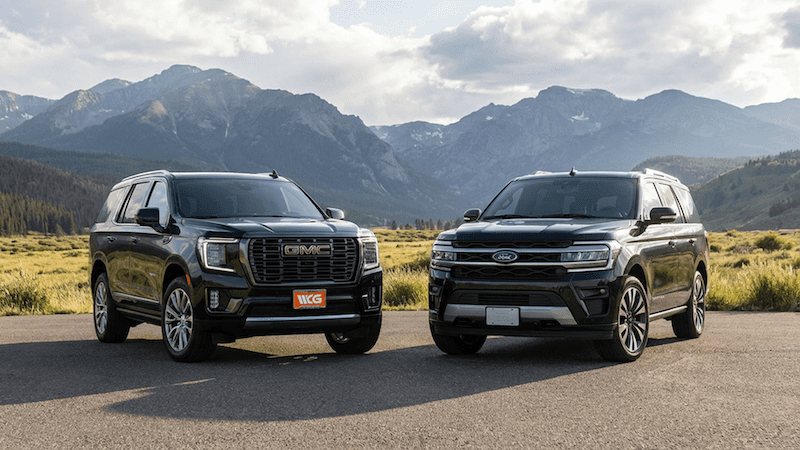
At a Glance
Which is better, 2026 GMC Yukon or Ford Expedition?
Yukon wins on: interior luxury (full-grain leather, open-pore wood), infotainment (16.8″ screen, largest in segment), and technology (Super Cruise now available on Elevation, hands-free in all conditions). Expedition wins on: max towing (9,600 vs 8,400 lbs) and base price (~$62K vs ~$69K). For Colorado buyers prioritizing tech, comfort, and altitude performance → Yukon and its diesel option. For heavy trailers and conventional truck buyers → Expedition.
When you’re shopping for a full-size luxury SUV in Northern Colorado, two giants stand out: the 2026 GMC Yukon and the 2026 Ford Expedition. Both are capable haulers with upscale interiors, advanced technology, and the power to handle mountain grades and Colorado’s demanding terrain. But they excel in different areas—and for Colorado buyers, the choice often comes down to whether you prioritize cutting-edge tech and interior luxury or maximum towing and traditional capability. This guide breaks down the honest differences.
Key Comparison
Engines, Towing & Technology
The Yukon gives you three distinct powertrain philosophies, while the Expedition offers one engine with proven performance. The Yukon’s advantage lies in flexibility and technology integration; the Expedition’s strength is maximum towing capacity and traditional truck feel.
| Feature | 2026 Yukon | 2026 Expedition |
|---|---|---|
| Starting MSRP | $69,200 (Elevation) | $62,000 (Active) |
| Top Trim Price | $103,900 (Denali Ultimate) | $90,000+ (King Ranch) |
| Engine Options | 3 (5.3L V8, 6.2L V8, 3.0L Duramax) | 1 (3.5L EcoBoost, 2 HP tunes) |
| Max HP | 420 hp (6.2L V8) | 440 hp (High-Output EcoBoost) |
| Max Torque | 495 lb-ft (3.0L Duramax) | 510 lb-ft (High-Output EcoBoost) |
| Max Towing | 8,400 lbs | 9,600 lbs |
| Max Payload | ~1,770 lbs (varies by config) | ~1,900 lbs (varies by config) |
| Infotainment Display | 16.8″ (largest in segment) | 15.5″ |
| Driver Info Display | 11″ | 12.3″ |
| Hands-Free Tech | Super Cruise (now on Elevation, free) | BlueCruise ($2,495 or $495/yr) |
| Air Suspension | AT4 Ultimate / Denali Ultimate | Not available |
| Heated/Cooled Front Seats | Available across trims | Available across trims |
| Massage Seats | Denali Ultimate (front & rear) | King Ranch (front & rear) |
| Rear Entertainment Screens | Dual 12.6″ (Ultimate trim) | Optional (single) |
| Resale Value (3-5 yr) | Traditionally 5-8% stronger | Solid, but Yukon slightly ahead |
Deep Dive Comparison
Engine Options: 3 Yukons vs 1 Expedition
The Yukon offers flexibility; the Expedition offers simplicity. The Yukon’s three-engine lineup (5.3L V8, 6.2L V8, 3.0L Duramax diesel) gives Colorado buyers options for different priorities. The Expedition’s single EcoBoost engine is modern and efficient, with two power tunes. For diesel lovers and those who want fuel economy at altitude, the Yukon diesel is unmatched.
Engine Details
2026 Yukon Engines
- 5.3L EcoTec3 V8 (L84): 355 hp / 383 lb-ft. Standard on Elevation and AT4. Efficient naturally aspirated design, no power loss at Colorado altitude. Best for balanced buyers.
- 6.2L EcoTec3 V8 (L87): 420 hp / 460 lb-ft. Standard on Denali. More power, best for towing in mountains. Still naturally aspirated—excellent at elevation.
- 3.0L Duramax Turbo-Diesel I6 (LZ0): 305 hp / 495 lb-ft torque. Available on all trims. Game-changer for Colorado. Unmatched low-end torque, better fuel economy, and forced-induction design actually thrives at altitude. Premium diesel cost ($2,000–$3,000) often pays back in fuel savings over 5 years.
2026 Expedition Engine
- 3.5L EcoBoost V6 Twin-Turbo: Two configurations: standard (400 hp / 480 lb-ft) and High-Output (440 hp / 510 lb-ft, standard on Tremor). Modern, EPA-efficient (turbocharged design), and paired with a 10-speed automatic. The EcoBoost performs well at altitude but requires careful thermal management on long mountain grades.
Colorado Verdict: The Yukon’s diesel option is the standout. Diesel’s high torque at low RPM and lack of power loss at elevation make it ideal for towing trailers over mountain passes. The naturally aspirated V8s in the Yukon (especially the 6.2L) are also more predictable at altitude than a turbocharged engine. If you’re comfortable with conventional gasoline and don’t tow heavily, both EcoBoost and the Yukon’s naturally aspirated V8s are fine. But for serious mountain work, the Yukon diesel is the choice.
Towing Capability
Expedition Wins on Paper
The Expedition’s 9,600 lbs beats the Yukon’s 8,400 lbs—but the Yukon diesel’s torque is legendary. Yes, the Expedition tows 1,200 lbs more. But here’s the nuance: the Yukon’s Duramax diesel produces 495 lb-ft—the most in the segment—making it better for hauling heavy loads up Colorado mountain grades. The EcoBoost’s twin-turbos deliver torque quickly, but that’s less forgiving at altitude on sustained climbs.
- 2026 Yukon: 8,400 lbs (5.3L V8 with Max Trailering Package, 2WD, short wheelbase). 4WD and long wheelbase reduce this slightly.
- 2026 Expedition: 9,600 lbs (standard across EcoBoost variants). This is the highest in the class, period.
Colorado Verdict: If you tow 9,000+ lbs regularly, get the Expedition. If you tow 7,000–8,000 lbs or less, the Yukon (especially the diesel) offers better real-world performance at altitude. Both have trailer stability control and integrated trailer brake controllers—equally safe.
Luxury & Interior
Yukon Denali Ultimate vs Expedition King Ranch
Both flagships are phenomenally well-appointed. The Yukon Denali Ultimate edges ahead on infotainment (16.8″ vs 15.5″ screen) and rear-seat tech (dual 12.6″ screens). The Expedition King Ranch delivers sophisticated brown leather and a quieter cabin. For Colorado luxury buyers who want the latest gadgets, the Yukon wins. For traditional luxury purists, the Expedition is equally convincing.
2026 Yukon Denali Ultimate: Full-grain leather seating and open-pore wood trim (hand-stitched leather on doors). 22-speaker Bose Performance Series audio (Expedition offers 18-speaker B&O)—Bose is known for warm, detailed sound. 16.8-inch infotainment (largest in segment) with Google Built-In for seamless Maps, Assistant, and Play integration. 11-inch driver information display. Dual 12.6-inch rear-seat entertainment screens (Expedition’s optional single screen can’t compare). 16-way power front seats with massage. 2nd-row executive seating with 14-way power, heated/ventilated, and massage. Standard Super Cruise (hands-free on I-25 Greeley to Denver and beyond). Air suspension with 4-inch height adjustment. MSRP: ~$103,900.
2026 Expedition King Ranch: Hand-stitched brown leather (King Ranch’s signature), more traditional Western aesthetic. 18-speaker Bang & Olufsen audio—rich midrange, smooth high-end. 15.5-inch infotainment (still excellent, but not the largest). 12.3-inch driver display. Heated and ventilated front seats, heated rear seats (no massage standard). Adaptive dampers and terrain management (Expedition’s equivalent to Yukon’s air suspension). BlueCruise optional (costs extra). MSRP: ~$90,000+.
Colorado Verdict: The Yukon Denali Ultimate is newer and tech-forward, with a compelling infotainment ecosystem. The Expedition King Ranch is deeply traditional and beautifully executed. If you live in Greeley or Fort Collins and spend time with the latest smart-home tech (Google Home, etc.), the Yukon’s Google Built-In feels at home. If you prefer classic luxury and don’t need the latest screens, the Expedition is equally serene and sophisticated.
Driver Assistance
Super Cruise vs BlueCruise
This is a game-changer for 2026. The Yukon’s Super Cruise (now available on the base Elevation trim) works on 500,000+ miles of North American highways and requires no subscription. BlueCruise is powerful but costs $2,495 upfront or $495/year after trial. For Colorado buyers who commute on I-25, Super Cruise is a significant advantage.
2026 GMC Super Cruise: NEW for 2026: Available on Elevation (base trim), standard on AT4 Ultimate and Denali Ultimate. Works on 500,000+ miles of mapped highways—covers I-25 from Denver to Wyoming and most Colorado interstates. Hands-free, no subscription required (included with purchase). Eye-tracking camera confirms driver engagement (safer than competitor systems). Seamless lane changes on supported highways (trusts your intent). On Elevation, it’s a software unlock. On AT4 Ultimate and Denali Ultimate, it’s standard—no cost.
2026 Ford BlueCruise: Available on Platinum, King Ranch, and Expedition Max trims (not on base Active trim). 90-day trial on Platinum and above; then $2,495 one-time or $495/year. Covers 130,000+ miles of divided highways—less coverage than Super Cruise, especially for Colorado. Hands-free on compatible roads; driver attention monitoring required. More limited functionality than Super Cruise (more conservative lane-change assist).
Colorado Verdict: If hands-free tech is important and you commute I-25, the Yukon is the clear winner. Super Cruise on the Elevation is a steal—you get premium tech on the cheapest trim. The Expedition requires stepping up to higher trims and paying a subscription. For Northern Colorado drivers, Super Cruise’s broader coverage and native I-25 support make it the better choice.
Off-Road Capability
AT4 Ultimate vs Expedition Tremor
Both are capable, but the AT4 Ultimate has one advantage: air suspension. The Expedition Tremor raised Ford’s off-road game significantly. For light-to-moderate off-road use (rocky trails, light rock crawling), it’s excellent. The Yukon AT4 Ultimate adds air ride with 4-inch height adjustment, making it more versatile for varying terrain. For serious Colorado backcountry, the AT4 Ultimate edges ahead.
2026 Yukon AT4 Ultimate: 2-inch factory lift (all AT4 variants). Skid plates under engine, transmission, transfer case. 4WD with auto-locking rear differential. Hill Descent Control (automatic braking on steep downhills). Four-Corner Air Ride Adaptive Suspension (AT4 Ultimate only) with 4-inch height adjustment—can raise for rock obstacles, lower for highway stability. Adaptive Dampers fine-tune suspension response in real-time. 20″ off-road tires (AT4), 22″ gloss black wheels (AT4 Ultimate).
2026 Expedition Tremor: Baja-inspired design with tuned suspension (independent front, live rear axle). Raised suspension (similar to 2-inch lift effect). 33-inch all-terrain tires (larger than Yukon’s standard 20″/22″). Skid plates under critical components. Terrain management modes (Slippery, Sand, Rock Crawl). Off-road-focused interior (rubberized door panels, tough upholstery). No air suspension option (conventional springs only).
Colorado Verdict: The Tremor is a genuine step forward for Expedition. For hiking trailheads around Estes Park or Horsetooth Reservoir, both are capable. But the Yukon AT4 Ultimate’s air suspension is a versatility advantage—you can adjust ride height on the fly, which matters when you’re picking your own line up a rocky wash. If you’re doing serious off-road exploration (not just park-and-hike), the AT4 Ultimate is better. The Tremor is excellent for adventure seekers who value off-road aesthetics and all-terrain tires.
Value & Ownership
Pricing & Resale
Expedition starts cheaper; Yukon offers more tech at all price points. The Expedition Active ($62K) undercuts the Yukon Elevation ($69.2K) by $7,200. But that Yukon comes with a 16.8″ screen and Google Built-In—features Expedition reserves for upper trims. At the top, the Yukon Denali Ultimate ($103.9K) costs more than the Expedition King Ranch (~$90K), but the gap in tech and interior refinement justifies it.
2026 Yukon Base Trims: Elevation: $69,200. Includes 16.8″ infotainment, Google Built-In, Apple CarPlay/Android Auto, Super Cruise-capable. AT4: $76,000–$76,600. Adds lift, skid plates, all-terrain tires, AT4 badging. Denali: $80,000–$83,400. Upgrades to 6.2L V8 standard, leather, wood trim, Magnetic Ride Control. AT4 Ultimate: $97,300–$97,900. Air suspension, adaptive dampers, premium audio, 22″ wheels. Denali Ultimate: $103,300–$103,900. Top-tier luxury, standard Super Cruise, air suspension, dual rear screens, massaging seats.
2026 Expedition Base Trims: Active: $62,000. Base tech (15.5″ screen), standard EcoBoost, no BlueCruise (requires $2,495). Tremor: $72,000+. Off-road focused, tuned suspension, 33″ tires, High-Output EcoBoost standard. Platinum: $80,000+. Luxury trims, heated/cooled seats, optional BlueCruise. King Ranch: $90,000+. Hand-stitched leather, 22″ wheels, traditional luxury flagship.
Colorado Value Verdict: If budget is tight, the Expedition Active saves $7,200 upfront. But you’re trading tech—no large screen, no free hands-free driving. The Yukon Elevation is better equipped as a base. At the top, the Yukon Denali Ultimate is pricier but delivers cutting-edge tech (dual rear screens, 16.8″ infotainment, standard Super Cruise). The Expedition King Ranch is a better value at $90K for traditional luxury. Choose Yukon for tech value; choose Expedition for luxury value and cash savings.
Reliability
Warranty & Long-Term Ownership
Both are reliable. Yukon has traditionally stronger resale. Both manufacturers offer identical 3yr/36K bumper-to-bumper and 5yr/60K powertrain warranties. Known issues: EcoBoost engines can build carbon deposits on intake valves (mitigated with fuel additives and regular service); both use shared 10-speed transmissions that have shown rare issues on early years (now refined). Yukon historically holds resale value 5-8% better, likely due to lower production volume and luxury brand positioning.
- Warranty Coverage (Identical): 3 years / 36,000 miles: Full coverage, parts and labor. 5 years / 60,000 miles: Powertrain coverage (engine, transmission, drivetrain). 6 years / 100,000 miles: Corrosion coverage (both).
- Known Issues: EcoBoost Carbon Buildup: Some earlier EcoBoost engines (2015–2019) experienced intake valve carbon deposits. Modern fuel system cleaners and Ford’s updated fuel formulation have largely mitigated this. Use Top-Tier gasoline and consider fuel system service every 100K miles. 10-Speed Transmission (Both Vehicles): A shared ZF transmission used by GMC and Ford. Occasional shift lag reported in very early 2020–2021 models; significantly improved in 2022+. The 2026 models have refined TCM programming. Yukon-Specific: No major recurring issues reported. Diesel engines are proven Duramax units (used across GM truck line).
J.D. Power and Kelley Blue Book data show Yukon typically holds 55–60% of MSRP after 5 years; Expedition holds 50–55%. The difference isn’t massive, but it favors Yukon. This is partly due to lower annual sales volumes (higher demand for used Yukons) and luxury brand halo.
Colorado Ownership Verdict: Both are solid choices for long-term ownership. Service them on schedule (every 10K miles oil change, rotate tires, fluid checks), use Top-Tier fuel, and both will easily last 150K+ miles. The Yukon’s slightly better resale value means lower long-term cost of ownership, but the difference is modest. For Colorado drivers, the most important factor is finding a trusted service center—and Weld County Garage GMC is 10 minutes from Greeley, so Yukon service is convenient.
Where Expedition Wins
Being Honest About Ford
We believe the Yukon is the better overall choice for Colorado, but the Expedition genuinely excels in a few areas. Here’s where Ford wins.
- Maximum Towing Capacity: 9,600 lbs vs. 8,400 lbs. If you regularly tow 8,500+ lbs or plan to hook up a large boat or RV, the Expedition has the legal capacity edge. The Yukon maxes out earlier.
- Starting Price: The Expedition Active starts at ~$62,000 vs. Yukon Elevation at $69,200. If your budget is fixed and you’re not concerned about infotainment screens and tech features, the Expedition saves $7,200 upfront.
- Payload Capacity: Expedition edges the Yukon on maximum payload (~1,900 vs ~1,770 lbs). For construction crews or ranchers who load heavy materials in the bed, this matters.
- Fuel Economy (Light Towing): The EcoBoost engine is optimized for efficiency on highway driving without a trailer. For daily commuting with light or no towing, the Expedition may see slightly better MPG than Yukon’s naturally aspirated V8s.
- Engine Simplicity: One engine option with two power tunes is easier to spec, finance, and service. No diesel complexity or premium fuel for the 6.2L. If you prefer conventional simplicity, Expedition delivers.
These are legitimate advantages. The Expedition is a fantastic vehicle. For heavy towers, budget-conscious buyers, and those who value payload and simplicity, it’s the right choice. Our recommendation: test-drive both at Weld County Garage. The differences become obvious when you’re behind the wheel.
Final Recommendation
Which Wins for Northern Colorado?
When you factor in altitude, mountain driving, tech infrastructure in Denver/Fort Collins, and the specific routes Northern Colorado buyers drive, the Yukon’s advantages stack up. Super Cruise on I-25, diesel torque on mountain grades, tech that integrates with your home ecosystem—the Yukon fits Colorado life.
- Altitude Performance: Both vehicles are fine at Colorado elevation (5,000–6,000+ feet in the mountains). The Yukon’s naturally aspirated engines (5.3L and 6.2L V8s) maintain power without turbo complexity. The diesel’s low-RPM torque is unmatched on climbs. The EcoBoost is modern and efficient but relies on boost at altitude—less intuitive for mountain drivers. Advantage: Yukon.
- I-25 Corridor (Greeley to Denver): Super Cruise coverage on I-25 is extensive. BlueCruise has gaps. For commuters on the I-25/I-76/I-270 corridor between Greeley, Evans, Windsor, and Denver, the Yukon’s hands-free tech is genuinely useful on monotonous stretches. You’re saving mental fatigue on a 90-minute highway drive—real quality-of-life benefit. Advantage: Yukon.
- Winter & Snow Performance: Both are excellent in snow. 4WD is standard across comparable trims. The Yukon’s air suspension (Ultimate trims) lets you raise ground clearance when roads are snow-packed—a genuine advantage on backcountry mountain roads after storms. The Expedition’s terrain modes are solid but fixed. Advantage: Yukon (for air suspension variants).
- Service & Support: Weld County Garage GMC is located at 2699 47th Ave, Greeley, CO 80634—just off I-25 Exit 243, 10 minutes from downtown Greeley and 45 minutes from Denver. GMC service is our specialty. Ford dealers are everywhere, but GMC expertise is here. Advantage: Yukon (convenience).
- Integration with Colorado Tech Ecosystem: If you use Google Home, Nest thermostat, or other Google ecosystem products, the Yukon’s Google Built-In (Maps, Assistant, Play) feels native. Ford’s Sync system is more traditional. For tech-forward Colorado households, the Yukon integrates seamlessly. Advantage: Yukon.
Final Colorado Verdict: The 2026 GMC Yukon is the better choice for Northern Colorado buyers—especially if you’re on I-25 regularly, plan mountain adventures, or want modern tech that integrates with your life. The 3.0L Duramax diesel is the standout powertrain for Colorado mountain driving. Super Cruise (free on Elevation trim) is a genuine advantage over BlueCruise’s subscription model. The Expedition is a fantastic vehicle and the right choice if you tow over 8,500 lbs regularly or need maximum payload. But for overall Colorado lifestyle fit, tech, and daily driving satisfaction in Northern Colorado, the Yukon wins.
Common Questions
Frequently Asked Questions
Weld County Garage GMC — Greeley, CO
Ready to Find Your Yukon?
Visit us at 2699 47th Ave, Greeley, CO 80634 or call 970-400-9952. Serving Northern Colorado since 1908.
0 comment(s) so far on 2026 GMC Yukon vs Ford Expedition: CO Guide