

2026 GMC Yukon vs Toyota Sequoia: CO Guide
2026 GMC Yukon
vs Toyota Sequoia: CO Guide
By Ryan Green, Marketing Director — Weld County Garage GMC | Updated April 2026
At a Glance
Which is better for Colorado?
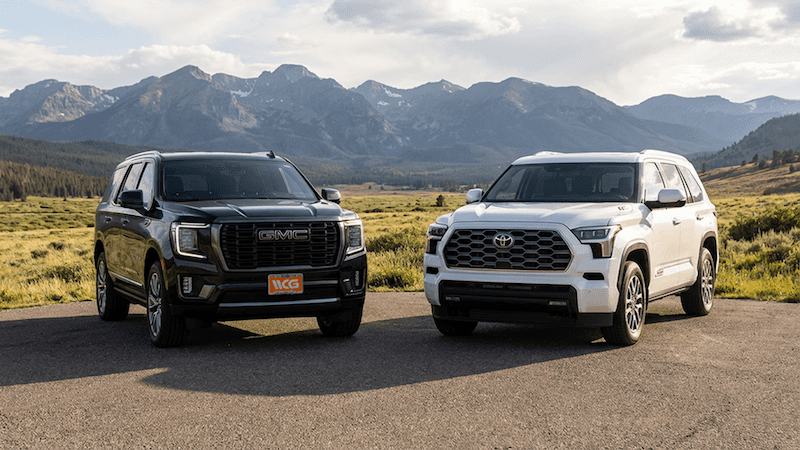
Sequoia wins on hybrid fuel economy, max towing (9,520 vs 8,400 lbs), and Toyota reliability reputation. Yukon wins on interior cargo space (122.9 vs ~86 cu ft), luxury tech (16.8″ display vs 14″), engine variety (3 engines vs 1 hybrid-only), Super Cruise hands-free driving, and dramatically smoother ride with Magnetic Ride or Air Ride Adaptive Suspension. For Colorado buyers wanting luxury, cargo flexibility, and long road trips: Yukon. For shorter in-town driving with fuel economy focus and maximum towing: Sequoia.
The choice between the 2026 GMC Yukon and Toyota Sequoia represents two completely different full-size luxury SUV philosophies. The Yukon emphasizes interior space, technology, and engine choice; the Sequoia doubles down on hybrid efficiency and Toyota reliability. For Northern Colorado buyers—from Greeley to Fort Collins to mountain communities—understanding these core differences is essential to picking the right truck for your lifestyle.
Powertrain Philosophy
Engine Options: Choice vs One-Size-Fits-All
The Yukon gives you three distinct powertrain philosophies. The 5.3L V8 (355 hp / 383 lb-ft) is the efficiency-minded choice. The 6.2L V8 (420 hp / 460 lb-ft) is pure performance. The 3.0L Duramax diesel (305 hp / 495 lb-ft) is the long-haul torque king. Which one you choose depends entirely on your driving pattern and Colorado use case. The Sequoia offers one engine: the 3.4L i-FORCE MAX hybrid (437 hp / 583 lb-ft)—excellent, but it’s the hybrid-or-nothing approach.
Cargo & Interior
Yukon’s Biggest Advantage
This is where the Yukon’s engineering shines. Maximum cargo capacity is 122.9 cu ft (short-wheelbase), with even more available on the XL. The Sequoia tops out at approximately 86 cu ft. That 37-cu-ft deficit is enormous—equivalent to the difference between a large pickup truck bed and a sedan trunk. But the real story is behind the third row. The Yukon provides 25.5 cu ft of usable space with third-row seats folded. The Sequoia delivers a notoriously cramped ~22 cu ft. For Colorado families planning multi-day mountain trips, ski vacations, or camping adventures with gear for four people, the Yukon’s space advantage is transformative. You can fit skis, bikes, luggage, camping equipment, and kids’ stuff without a roof rack. The Sequoia’s tight cargo design is Toyota’s long-standing weakness in the full-size segment. It’s a significant trade-off for hybrid efficiency gains.
Towing Capacity
Sequoia Wins on Paper
Let’s be honest: the Sequoia’s 9,520-lb max towing capacity beats the Yukon’s 8,400-lb rating. That 1,120-lb advantage is real. The hybrid’s 583 lb-ft of torque is genuinely impressive and delivers smooth, linear pulling power without engine strain. However—and this is critical for Colorado mountain towing—the Yukon Duramax diesel delivers 495 lb-ft from an internal combustion engine without electric assist, and it matches the Sequoia’s highway fuel economy (~23 mpg) on I-25 commutes to the Front Range. The diesel’s torque characteristics are ideal for sustained mountain grades and long-haul trailer work. Additionally, the Yukon includes more complete towing technology: Transparent Trailer View (see your trailer behind you on the infotainment screen), Hitch Guidance, integrated brake control, and trailering stability control. Verdict: Sequoia wins on max towing capacity. Yukon Duramax wins on real-world mountain towing experience and long-haul torque. If you’re pulling a 9,000-lb boat or gooseneck trailer across Colorado passes, the Duramax is your truck.
Fuel Economy
Hybrid vs V8: Colorado Context
The Sequoia hybrid achieves approximately 20 mpg combined—a significant advantage over the Yukon 5.3L V8 at roughly 16 mpg combined. Over a year of typical Colorado driving, you’ll save several hundred dollars on fuel with the Sequoia. However, the Yukon Duramax diesel matches the Sequoia’s highway efficiency at roughly 23 mpg on the open road. For Greeley-to-Denver I-25 commuters (the corridor many Northern Colorado executives drive), the Duramax diesel provides equivalent fuel economy to the hybrid, plus superior torque and towing capacity. The diesel is $1,500–$2,500 more expensive upfront, but the fuel economy advantage closes that gap quickly. The 5.3L V8 uses more fuel, but it’s the base engine on Elevation and AT4 trims, keeping purchase price lower. For budget-conscious buyers, the V8 is economical to own overall; for long-haul efficiency, the Duramax or Sequoia hybrid are smart choices.
Technology & Driver Assistance
Yukon Pulls Ahead
The Yukon’s 16.8-inch infotainment display is the largest in the segment and includes Google Built-In Maps, Google Assistant, and Google Play integration. The Sequoia’s 14-inch screen is solid but smaller. Both have Apple CarPlay and Android Auto, but the Yukon’s standard Google ecosystem creates a more integrated, smartphone-like experience.
Super Cruise hands-free driving is available on the Yukon Elevation (NEW for 2026) and standard on AT4 Ultimate and Denali Ultimate trims. Super Cruise uses cameras and radar to provide true hands-free highway driving on over 500,000 miles of compatible roads—including I-25 from Greeley to Fort Collins to Denver. The Sequoia’s Toyota Safety Sense 3.0 includes adaptive cruise and lane centering, but you must keep your hands on the wheel. Super Cruise is a substantial advantage for long Colorado commutes.
The Denali Ultimate offers dual 12.6-inch rear-seat entertainment screens for passengers, which the Sequoia doesn’t match. For families, this is a game-changer on long road trips through the Rockies. Technology advantage: Yukon, by a comfortable margin.
Suspension & Ride Quality
Colorado Mountain Comfort
The Yukon’s Magnetic Ride Control (standard on Denali and AT4) uses electronically controlled dampers to adjust suspension stiffness in real-time. The AT4 Ultimate and Denali Ultimate add Four-Corner Air Ride Adaptive Suspension, which offers 4 inches of height adjustment and dramatically superior ride smoothness. This technology is exceptional on Colorado’s frost-heaved rural roads and mountain highways.
The Sequoia uses a traditional solid rear axle with leaf and coil springs. It’s a proven design, but it delivers a notably busier, more jarring ride on rough pavement and mountain passes. Colorado’s winter freeze-thaw cycle creates significant road deterioration, and the Sequoia’s suspension doesn’t absorb these impacts as gracefully as the Yukon’s active systems. If ride quality matters—and it does on long Colorado road trips—the Yukon’s suspension technology is a genuine quality-of-life advantage.
Off-Road Capability
AT4 Ultimate vs TRD Pro
The Toyota TRD Pro is a true off-road specialist. It comes standard with FOX adaptive dampers, integrated skid plates, an electronic locking rear differential, Hill Descent Control, and aggressive 33-inch all-terrain tires. If your Colorado adventures take you deep into the backcountry—say, high-altitude four-wheeling above 10,000 feet or serious canyon driving—the TRD Pro is factory-equipped to handle it immediately.
The Yukon AT4 Ultimate offers a 2-inch factory lift, skid plates, auto-locking rear diff, Hill Descent Control, and all-terrain tires. The major difference is the Yukon’s Air Ride Adaptive Suspension is more luxury-focused than the TRD Pro’s hardcore off-road setup. The AT4 Ultimate is a versatile luxury/off-road hybrid—excellent for weekend mountain driving and light backcountry exploration, but not as specialized as the TRD Pro for serious rock-crawling. Verdict: TRD Pro is the more focused off-roader. AT4 Ultimate is more capable across more use cases (daily driving + weekend adventure). For serious Colorado backcountry, TRD Pro; for balanced luxury + trail capability, AT4 Ultimate.
Reliability & Value
Long-Term Ownership
Toyota’s reliability reputation is well-earned, especially on the previous-generation Sequoia. The new 2026 model’s i-FORCE MAX hybrid powertrain is untested long-term, however. There’s no field data yet on hybrid transmission durability, battery longevity, or the hybrid system’s behavior after 100,000+ miles.
The Yukon’s 5.3L V8 (L84) and 6.2L V8 (L87) are proven GMC/Chevrolet engines with decades of reliability history. The Duramax diesel has proven durability in heavy-duty trucks and is increasingly common in GMC and Chevy applications. GMC warranty (3 years/36,000 miles basic, 5 years/60,000 miles powertrain) matches Toyota’s coverage.
Both vehicles should hold value well in Colorado’s stable luxury SUV market. Toyota resale strength is historically 1-2% higher, but the Yukon’s larger size and cargo utility may appeal more to Colorado families on the used market. Five-year resale projections for both vehicles are likely in the 50–60% range. Honestly, Toyota reliability reputation wins here, but the Sequoia’s new hybrid is unproven, while the Yukon’s engines are battle-tested.
Being Fair
Where the Sequoia Wins
To be completely fair, the Sequoia has clear advantages in specific areas: Hybrid Fuel Economy: 20 mpg combined is superior to the Yukon 5.3L V8’s 16 mpg, saving money on gas every month. Maximum Towing Capacity: 9,520 lbs beats the Yukon’s 8,400 lbs—a real advantage if you regularly pull heavy trailers. Toyota Reliability Reputation: Toyota’s long history of dependability is a proven brand advantage, even with the new hybrid powertrain. Federal Tax Credit Eligibility: The Sequoia hybrid may qualify for federal EV incentives (check current IRS guidelines), reducing effective purchase price. Trim Options: Six trim levels (SR5, Limited, Platinum, TRD Pro, 1794 Edition, Capstone) offer more granular choices than Yukon’s five. Off-Road Specialization: The TRD Pro is factory-ready for serious backcountry driving without modification.
Final Verdict
Which Wins for Northern Colorado?
Here’s the bottom line for the Greeley, Fort Collins, Loveland, and Windsor corridor:
Choose the Sequoia if: You commute primarily in town or short highway stretches (Denver/Boulder day trips), want maximum fuel economy, prioritize Toyota reliability reputation, and can live with tight cargo space. The hybrid’s 20 mpg will save you money every month on your Greeley routes.
Choose the Yukon if: You take frequent Colorado road trips (mountains, national parks, ski towns), need cargo space for family adventures, commute on I-25 (where Super Cruise shines), want interior luxury and technology, or prefer engine variety. The Duramax diesel matches the Sequoia’s highway efficiency while delivering superior torque and towing. Magnetic Ride/Air Ride suspension is noticeably smoother on Colorado’s rough winter roads.
The Colorado lifestyle tiebreaker: Northern Colorado is outdoor country. Mountain passes. Camping. Fishing trips. Weekend getaways to Trail Ridge Road and Poudre Canyon. If your vehicle is built for Colorado adventure—carrying skis, mountain bikes, camping gear for a family of four—the Yukon’s 122.9 cu ft of cargo space, available dual rear screens for kids, and smoother suspension win the Colorado test. The Sequoia is more efficient in a parking lot or on flat Denver streets; the Yukon is more versatile on Rocky Mountain roads.
At Weld County Garage GMC in Greeley, we serve families who do more with their vehicles. The Yukon is engineered for that life.
Common Questions
Frequently Asked Questions
Weld County Garage GMC — Greeley, CO
Test Drive the 2026 Yukon Today
Visit us at 2699 47th Ave, Greeley, CO 80634 or call 970-400-9952. Serving Northern Colorado since 1908.
0 comment(s) so far on 2026 GMC Yukon vs Toyota Sequoia: CO Guide